NEIL'S RECIPES: FILLET OF HALIBUT WITH SAMPHIRE AND CHANTERELLES

by Cafe St Honoré in


"Get your fishmonger to do the hard work and fillet the fish for you. As an alternative to halibut, try hake, or smoked haddock works well. Fish goes really well with chanterelles and it’s the start of the mushroom season here in Scotland, so these vibrant orange fungi are easily foraged. If you do go picking, be careful and make sure you know what you are doing. Salty samphire brings all the flavours together nicely. It grows wild on coastal marsh areas in East Lothian but you should get permission from the landowner before any form of foraging."

Image: Paul Johnston, Copper Mango

Image: Paul Johnston, Copper Mango

Serves 4

INGREDIENTS

4 175g halibut fillets, farmed Gigha Halibut is great
1 handful of British samphire, washed
2 handfuls of chanterelles mushrooms, cleaned
A few flowers from the garden, I like nasturtium leaves and flowers, borage is pretty too
2 tablespoons of rapeseed oil
150g butter
Juice of a lemon, some fennel fronds, optional
Good salt and pepper

Season the fish all over. Heat a frying pan and a pot on the hob, bringing both to moderate heat. Add the oil to the frying pan and leave for a couple of minutes. Then add half the butter and the mushrooms to the pot, followed by the samphire and season. Keep tossing being careful not to burn the butter.

Meanwhile, check the fish. It should be starting to turn golden brown on the underside. Once it is, turn each fillet over and continue cooking. Add the remaining butter to the frying pan. It will start to froth and become lovely and nut brown in colour. Season the fish again and squeeze in the lemon juice, a few drops at a time. If you like, add some fennel fronds at this stage, as they will flavour the butter well.

When the mushrooms and samphire are just soft, season again and spoon into the centre of four warmed plates. Place the fish on top and decorate with the flowers and a few more drops of lemon.


NEIL'S RECIPES: ICED CROWDIE AND RASPBERRY PARFAIT

by Cafe St Honoré in


"The taste of this parfait is similar to a frozen cheesecake with the slightly salty, textured crowdie mixed with the sweetness of Angus raspberries. It just knocks me for six every time I eat it. Scattering a few oats as a tiny crust is great, or have it on its own, in a glass, bowl or plate, it doesn’t matter. Once it’s made, it’s in your freezer for a good few weeks until it’s all eaten! Do give it a go, maybe ask for help as there are a few stages to go through. Come on, I did give you an easy starter and main course to cook!"

Image: Paul Johnston, Copper Mango

Image: Paul Johnston, Copper Mango

This will make 2 terrine moulds (classic le Creuset style) or ice-cream tubs rubbed with oil and lined with 2 sheets of cling film. Very importantly, before lining with oil and cling film, add a strip of triple layered tin foil so you can lift the parfait out of the terrine when it’s frozen. Allow for an overhang of the tin foil and the cling film.

INGREDIENTS

350g raspberries, chopped plus extra for garnishing

Roasted pinhead oats, toasted as a garnish, optional

coulis:
150ml water
140g sugar
175g raspberries

creamed crowdie:
300ml double cream
600g crowdie

meringue:
4 egg whites
250g sugar
pâte à bombe

110 ml water
150g sugar

8 egg yolks

METHOD

Begin by making a coulis. Boil the coulis ingredients together until syrupy then blitz and pass through a sieve. Keep to one side. 

Next make the crowdie cream, by whisking together the cream and crowdie until smooth. Keep to one side. 

To make a classic meringue mix, whisk the egg whites until 3/4 whisked then add the sugar a little at a time as you continue to whisk. Use a mixer for this if you have one. Keep to one side.

To make the pâte à bombe parfait mixture, heat the water and sugar until it reaches 121°C. Meanwhile, whisk the egg yolks and continue to whisk as you gently pour in the molten sugar. Use a miser for this if you have one. Keep whisking until the mix starts to cool slightly. This will take about 5 minutes.

To assemble, use a large bowl to fold the meringue into the pâte à bombe. Then fold in the coulis and crowdie cream, being very gentle as you go. And finally fold in the chopped raspberries.

Ensure all is combined and scoop into your prepared terrine moulds. Fold the cling film over the top and freeze overnight. The next day, remove the parfait from the moulds by lifting out using the tin foil handles.

Serve sliced with some toasted oats and fresh raspberries.


NEIL'S RECIPES: MONKFISH TAIL WITH SALSA VERDE AND SEMI-DRIED TOMATOES

by Cafe St Honoré in


It is a rare treat for me to use monkfish. Always ensure you buy from a sustainable source and it’s very fresh. Monkfish has a meaty texture with no small bones, just one central bone that can be left in if you want to cook it on the barbecue, or trimmed and the bone removed. Either way, don’t overcook the fish - keep it slightly underdone and allow to rest as it does go a bit dry if it’s over cooked. I’m serving here with salsa verde, a brilliant sauce a bit like pesto, but so much better.

Image: Paul Johnston, Copper Mango

Image: Paul Johnston, Copper Mango

Serves 4

INGREDIENTS

1 large monkfish tail, either on or off the bone, get your fishmonger to help you trim it or remove the bone
4 large new season tomatoes, I like Isle of Wight organic tomatoes
A small handful each of fresh mint, parsley and basil, washed and dried
1 tablespoon of capers
1 tablespoon of anchovies, optional
1 tablespoon of good Dijon or wholegrain mustard
250ml extra-virgin olive oil, I use Palestinian organic olive oil, plus extra for roasting the tomatoes
A splash of red wine vinegar
1 clove of garlic
A few sprigs of thyme
Good salt and pepper
A few edible flowers, optional
A splash of sunflower oil
Lemon juice for seasoning

METHOD

Pre-heat oven to 130°C.

To make the semi-dried tomatoes, remove the eyes from the tomatoes and cut them half . Then cut each half into 4 wedges and place in an oven-proof dish. Trickle with a little olive oil, season with salt and pepper, and sprinkle over the thyme leaves. Place in the oven for a few hours until just semi-dried.

To make the salsa verde, blitz the herbs, capers, anchovies, vinegar, garlic and mustard, and olive oil in a blender until a slightly chunky consistency is achieved. Taste and season as required.

Prepare the fish for cooking by patting it dry and seasoning. Then place a frying pan on the hob and add a splash of sunflower oil. Once the oil is very hot add the monkfish very carefully. Colour the fish on all sides then season again and place in a hot (180°C) oven for a few minutes until it is still slightly under cooked.

Remove from the oven and season with a squeeze of lemon juice and salt and pepper if required.

To serve, slice the fish and drizzle with salsa verde and serve with the tomatoes.


NEIL'S RECIPES: BREAST OF MALLARD WITH CHESTNUTS, CABBAGE AND POTATO

by Cafe St Honoré in


Mallard, or wild duck, is one of my favourite game birds and is a great alternative to turkey for Christmas lunch. They’re available from good game dealers – in Edinburgh I would try Crombie’s, George Bower or Saunderson’s. If you choose a whole bird, I would recommend removing the legs and cooking them separately for longer than you do the breasts or the crown. Cooking the breasts on the bone will lessen the shrinkage and keep it moist but you can cook single breasts in a pan if you prefer.

Image: Paul Johnston, Copper Mango 

Image: Paul Johnston, Copper Mango 

Serves 4

INGREDIENTS

4 breasts of mallard

4 heritage potatoes or new potatoes, skin on and par-boiled - I like Pink Fir and Aura

1/2 a Savoy cabbage, stem removed and shredded

12 chestnuts

4 cloves of garlic

4 sprigs of thyme

Good salt and pepper

2 tablespoons cold-pressed rapeseed oil

4 knobs of butter

METHOD

Heat the oven to 180°C.

Add the oil to a large, hot frying pan, season the mallard and place each breast carefully, skin-side down in the pan. Season again.

Cut the potatoes in half and place them next to the breasts. Add the garlic and thyme. Once the mallard skin is golden, turn and add the chestnuts. Reduce the heat and cook for a minute or 2.

Place the pan in the oven for 3 to 5 minutes depending on how cooked you like your duck. Remove from the oven, add 2 knobs of butter to the pan and baste the mallard. Season again. Remove the mallard from the pan and allow rest on a plate in a warm place. Remove the potatoes from the pan and keep warm. Retain the juices in the pan.

Blanch the cabbage in boiling, salted water and drain, and add the remaining butter. Season and stir in any juices from the pan. Duck fat is delicious in cabbage! You can also add any resting juices.

To serve, slice each breast into long slithers and arrange on a wooden board or 4 individual, warmed plates. Arrange the cabbage, chestnuts and those golden brown potatoes and garnish with the garlic cloves and thyme stalks. Add a pinch of good salt and serve at once.


NEIL'S RECIPES: PORTOBELLO MUSHROOM WITH SPINACH, WHITE SAUCE AND HERB CRUMB

by Cafe St Honoré in


Such a good dish to eat, a joy to cook and a test of skills! For me it's rare for a dish to be so long in prep. You can simplify this by removing the chard or the white sauce, but I encourage you to make this delicious and classic sauce. The onion cloutie, studded with bay and clove, gives this humble and versatile sauce its edge. Don't rush it, take your time and enjoy beating the hot milk into the butter and flour. 

Image: Paul Johnston, Copper Mango

Image: Paul Johnston, Copper Mango

Serves 4

INGREDIENTS

A big handful of rainbow chard, washed and dried, roughly chopped

A shallot, peeled and finely chopped

2 bay leaves

A few sprigs of thyme

3 tablespoons organic olive oil

A splash of white wine

250ml double cream

500ml full fat milk

150g butter

50g plain flour

1 small onion

3 cloves

4 cloves of garlic

4 large handfuls of baby spinach, washed and dried

4 field/ flat or Portobello mushrooms

A small handful of herbs you like, tarragon and parsley work well

A handful of breadcrumbs

A few chanterelle mushrooms

A knob of butter

Good salt and pepper

METHOD

Firstly, prepare the chard.  Sweat the shallot in a tablespoon of olive oil with a bay leaf and a sprig of thyme. Add the chard and cook on a medium heat until soft. Season. Next add the white wine to the pot and cover with a lid. Add a little water or stock if you prefer. Let the chard braise for about an hour. Remove the lid and allow some of the liquid to evaporate for a few minutes whilst keeping the heat on medium setting. Then add the cream, bring to the boil and reduce until a sauce consistency. Season to taste and leave to one side in a warm place.

Make an onion cloutie by attaching a bay leaf to the onion with the cloves. To make a white sauce, heat the milk with the onion cloutie. Be careful not to boil. In another pot, melt 50g of butter and stir in the flour until you achieve a texture like wet sand. Cook the flour through for a minute or two, but don't burn it. Keep it on a low heat and add the milk a little at a time, continuing to stir. When all milk has been added, you should have a rich, glossy sauce. Add the onion to the sauce and cover with a lid. Keep warm.

Clean the Portobello mushrooms with a wet cloth and season all over. Place them on a roasting tray and dot over with the remaining butter. Season again. Gently bash the garlic, and rip a few sprigs of thyme. Add these to the roasting tray and place in a hot oven (180°C) for 20 to 30 minutes until just soft. Remove from the oven (leave the oven on). Leave the mushroom on the try and keep warm.

To wilt the spinach, heat a little olive oil in a pot with the juices from the mushrooms. Cook the spinach until wilted and season.

Make a herb crumb by mixing the herbs with breadcrumbs in a food processor.

Top each mushroom with some spinach, then one or two tablespoons of white sauce, finished off with the herb crumb. Return to the oven and bake at 180°C for 10 to 15 minutes.

Meanwhile, place the knob of butter in a medium hot frying pan and cook the chanterelles for a couple of minutes, or until cooked.

To serve, place two tablespoons of the creamed chard on each plate and top with a Portobello mushroom. Arrange the chanterelle mushrooms in a circle around the plate. 


NEIL'S RECIPES: HERRING ROLL MOPS

by Cafe St Honoré in


"People have been pickling herring since medieval times. In Old Norse ‘herring’ means ‘army’. These vast silver shoals were on the move and needed to be contained and conquered! Pickled herring makes a refreshing change from smoked trout or mackerel and is low in fat and high in Omega 3. It’s easy to make at home and will keep the fridge for weeks. Pack some for a picnic or be brave and put one in the kid’s packed lunch box!"

Image: Paul Johnston, Copper Mango

Image: Paul Johnston, Copper Mango

Serves 4

INGREDIENTS

4 fillets of the freshest herring your can buy

2 shallots, peeled and sliced into rings

1 carrot, peeled and sliced into thin slices

A few peppercorns

A small sprig of thyme

1 tablespoon of salt

200ml cider vinegar

200ml water

50g sugar

1/2 bulb of fennel, shaved thinly on a mandolin

1 radish, sliced

1 apple, cut into matchsticks

Salt and pepper for seasoning

METHOD

Make the pickle liquor first by bringing the vinegar, water and sugar to the boil with the carrot, shallot, peppercorns, thyme and pinch of salt. Remove from the heat as soon as it reaches boiling point and allow to cool in the fridge, it must be cold.

Meanwhile, rub the salt into the herring fillets and leave them to cure overnight. The next day, rinse them well, then roll them up from tail to head and secure with a cocktail stick.

Submerge the fillets in the chilled pickle liquor and leave for 2 to 3 days before eating.  

To serve, slice the roll mops and arrange them on a plate, with some of the carrot and shallot from the pickling liquor, and top with a few slices of radish, the apple matchsticks and some shaved fennel. Season with salt and pepper and serve.


NEIL'S RECIPES: GRILLED LAMB CHOPS WITH YOGHURT AND CUCUMBER

by Cafe St Honoré in


This recipe is inspired by a recent family holiday to the wonderful sun-baked island of Crete. I'm using best end of lamb here but you can use gigot chops. I'm going to suggest you cook it a little more than medium. I usually like my chops rare but to be true to Crete, I think a more well-done chop works better with the tzatziki. It's good idea is to marinade the lamb in a little olive oil with thyme and fennel seeds the night before cooking.

Serves 4

INGREDIENTS

Allow for 3 to 4 chops person - ask your butcher or stall-holder to French trim them

A few sprigs of thyme and marjoram

400g 10% full-fat natural Greek yoghurt - try Total, it’s very good, but a organic one is would be even better

1 medium-sized cucumber

1 small clove garlic, crushed

Good salt and pepper

A drizzle of olive oil – from Crete if you can

Half a lemon

METHOD

Place a griddle on the hob to heat whilst you marinate the chops in olive oil, thyme and marjoram (reserve some of the herbs for garnish). Aim to get the griddle to a moderate heat.

Grate the cucumber into a bowl. Squeeze the water out of the cucumber and mix in the yoghurt and crushed garlic. Season with a little salt and pepper.

Remove the excess oil and herbs from the chops and place onto the griddle and cook for around 5 to 7 minutes on each side in total - check them as you go and turn frequently. Don't cook to well done stage, but don't cook too rare either.

At the end of cooking, season the chops and squeeze over the juice of half a lemon. Serve with a huge dollop of the yoghurt mix and garnish with some marjoram and thyme.


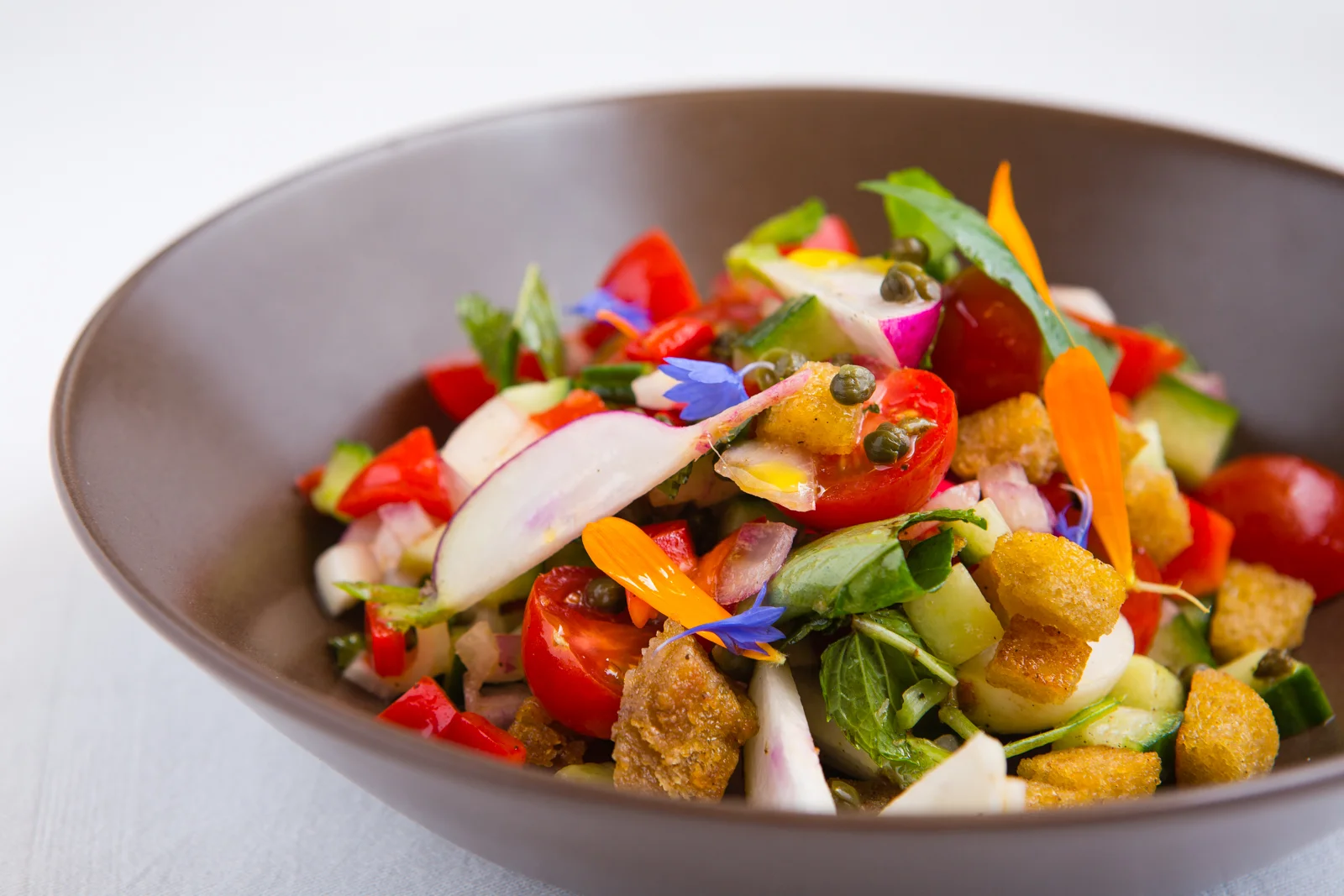
NEIL'S RECIPES: ISLE OF WIGHT TOMATO AND SOURDOUGH PANZANELLA

by Cafe St Honoré in


This is one of the simplest and most delicious salads you can make. A wonderful combo of stale bread, salty, zingy capers and sweet, fat Isle of Wight tomatoes. I love it and serve it in many ways at the restaurant: with grilled fish, or a simple goats’ cheese, but I also love it on its own. The addition of Summer Harvest bramble vinegar gives it a wonderful rounded flavour and makes it something special. Originating in Italy it’s a brilliant way to use up leftover bread. We use day-old sourdough fried in butter, oil and salt to bring it back to life. This salad is great at a barbeque, and can even be made the day before.

Serves 4

INGREDIENTS

1/3  loaf of sourdough, crusts removed

A big handful of Isle of Wight tomatoes, cherry toms are good

1/2 cucumber, seeds removed

1 Ramiro pepper, the long red ones

1 large red onion, peeled and finely chopped

1 tbsp capers

A small handful of basil and mint leaves

50ml Summer Harvest bramble vinegar

75ml Summer Harvest cold-pressed rapeseed oil

A few radishes

A knob of butter

Good salt and pepper

METHOD

Heat 25ml of oil in a frying pan and add the butter. Meanwhile, cut the bread into 1cm cubes, and then fry them in the pan tossing and seasoning all the time until they just start to turn golden. Set to one side on kitchen paper.

In a large bowl, mix the finely chopped red onion with the vinegar then remaining oil; it takes the harshness away by adding it first.

Dice the pepper, cucumber and cut the cherry toms in half, then add to the bowl with the capers. Slice a few radishes and add those to the bowl as well.

Next, add in the croutons then rip the basil and mint leaves gently (being careful not to bruise them) and add to the bowl too. Season and mix gently.

Use your taste buds to figure out if it needs more of this or that. Serve with grilled meats, fish or cheese. Delicious! 


NEIL'S RECIPES: ARRAN WHISKY AND OAT PARFAIT

by Cafe St Honoré in


Last month I set off from the Ayrshire coast bound for Arran. After a wonderful (if slightly choppy) hour on the ferry, the island appears standing majestic and strong, looking like a location from Lord of the Rings with its snow-capped peaks welcoming us. What a spectacular sight it is!

Stepping onto the jetty at Brodick, we’re met by Kim Ryan who will be our guide for the day, along with Gordon Kinniburgh from Arran Cheese. After a quick bag drop at the Douglas Hotel, a splendid Edwardian hotel with grand rooms and a great restaurant, we’re ready for the tour.

I'm here with a few others as a guest of Taste of Arran, to learn about the fabulous produce on this beautiful island. After a short drive through the pretty countryside, our first stop is to see how the famous Arran Mist and Arran Blue are made. These cheeses are only made in small batches and only ever released when they’re in perfect eating condition. I like this approach, and it's inspiring to see true artisans at work. Callum the cheese-maker is very knowledgeable and answers all our questions.

Next stop is The Arran Butcher Shop, a family-run business that’s been operating for decades and is still going strong. They make their own black puddings and haggis, as well as selling many cuts of meat including ‘coos tail’ (or oxtail), which I love.

Time is precious, so next we head off to see the production of oatcakes at Wooleys of Arran, a traditional family bakery. It’s a relatively small operation and it’s great to see the staff working together to create a very distinct-tasting oatcake. 

Finally, we just have time to make a brief tour of the distillery (a bottle was bought!) where we meet Taste of Arran’s founder Alastair Dobson, who does a wonderful job making ice-cream at Arran Dairies as well as spreading the word about this unique Island. I must thank our guide Kim who was brilliant. Let’s show our support - when you see the name Arran - buy it!

How to describe this pudding? Iced, smooth, oaty, rich, with bright egg yolks and that distinct whisky. I’ve used a 10-year-old Arran Malt with notes of citrus and honey followed by vanilla and butterscotch on the palate. It makes a wonderful parfait. I’ve only recently started to appreciate whisky properly and am better at distinguishing all those complex flavours. I know some people don't really get it, but go on, give it a try!

Image: Paul Johnston, Copper Mango

Image: Paul Johnston, Copper Mango

Serves 4 

INGREDIENTS

4 organic egg yolks

125g caster sugar

100mls water

500mls double cream

A good splosh of 10-year-old Arran whisky

A handful of pinhead oats, lightly toasted

A handful of porridge oats, fried in butter and sugar until golden

A few Scottish strawberries

Sweet cicely for a garnish

 METHOD

Add the water and the sugar to a pan and gently bring to the boil. It must reach soft-ball texture, so it looks like a clear syrup. Whisk the egg yolks and trickle in the sugar solution a little at a time - you can use a Kenwood for this - until the mix is full of volume. Allow this mix to cool for about 10 minutes.

In a clean bowl, semi-whip the cream until it reaches ribbon stage. Then gently fold it into the egg yolk and sugar mix, using a cutting/folding action.

Add the whisky to taste, then the toasted pinhead oats and combine. Pour into a terrine mould double-lined with cling film and freeze overnight.

To serve remove from the freezer, tip the parfait out of the mould and remove cling film. Then cut into slices and place on cool plates and serve with a few berries, some sweet cicely and some of those buttery sugary oats. Now eat!


NEIL'S RECIPES: WILD SCOTTISH RABBIT, BUTTER BEANS AND PRESERVED LEMONS

by Cafe St Honoré in


Rabbit is a delicious meat, hugely versatile, sustainable and local. Try wild Scottish rabbit and use the back legs and shoulders for braising, or cooking slowly in duck fat like a confit. The loins can be quickly sautéed and kept quite rare. Served with a few butter beans and a kick of preserved lemon and thyme, it’s lovely and simple, hot or cold. Don't be afraid to have a go at butchering your own rabbit, it’s good fun and you’ll be so chuffed if you get it right. I usually leave the hind legs on the bone during cooking as it seems to stay moist and juicy that way. And remember to add lots of parsley! 

Image: Paul Johnston, Copper Mango

Image: Paul Johnston, Copper Mango

Serves 4

INGREDIENTS

1 large organic unwaxed lemon

1 large cup of course salt

1 whole wild Scottish rabbit

250g duck fat

A few sprigs of thyme

A clove of garlic

200g butter beans, soaked overnight and cooked in water gently for 1.5 hours until just tender

A small handful of curly parsley, chopped

100ml cold-pressed rapeseed oil

A knob of butter

1 shallot, finely chopped

Good salt and pepper

METHOD

To make preserved lemons simply make a cross cut 2/3 of the way down the lemon and fill with salt, put the remaining salt into a jar and submerge the lemon in this for a month turning every 2 to 3 days. After a month, remove from the salt and rinse. Scrape out the insides and discard - it’s the pith and the peel you want. Chop finely.

Heat the duck fat and with the thyme and garlic, then add the seasoned front and back legs of the rabbit. Cook for 2 to 3 hours, submerged in the fat, until tender. Don't overcook.

Add the chopped shallot to the rapeseed oil and gently cook on the hob on a low heat until the shallot is translucent, about 5 minutes. Add the preserved lemon, and the butter beans.

Remove the cooked legs of rabbit from the duck fat and flake the meat into the bean mix and stir.

Heat the butter in a pan and fry the loins for 3 to 4 minutes being careful not to overcook. Slice and add to the bean mix.

Stir in the parsley and check the seasoning. Remember, the lemon is a little salty but a wonderful addition to this dish.

Serve in a bowl - not too hot - a bit like a warm salad.